
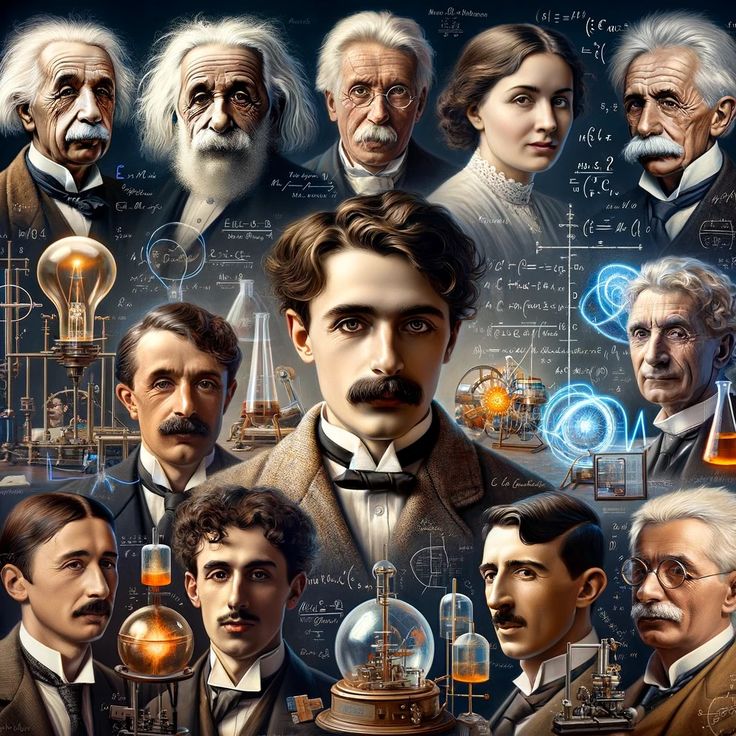
Pioneers of Science and Human Knowledge
The Role of Scientists in Shaping the World
Throughout history, scientists have played a crucial role in transforming human understanding of nature, the universe, and life itself. Their discoveries have challenged old beliefs, introduced new ways of thinking, and laid the foundation for modern technology, medicine, and industry. Famous scientists are remembered not only for their intelligence but also for their curiosity, persistence, and willingness to question the unknown. By studying their discoveries, we gain insight into how scientific knowledge evolves and how individual contributions can change the course of civilization.
Isaac Newton and the Laws of Motion
Foundations of Classical Physics
Isaac Newton is widely regarded as one of the most influential scientists in history. His work in the seventeenth century laid the groundwork for classical physics. Newton formulated the three laws of motion, which describe how objects move and interact with forces. These laws provided a mathematical framework that could explain everything from falling apples to the movement of planets.
Universal Gravitation
In addition to motion, Newton discovered the law of universal gravitation. This principle explained that every object in the universe attracts every other object with a force proportional to their masses and distance. This discovery unified earthly and celestial mechanics, showing that the same physical laws apply everywhere.
Albert Einstein and the Nature of Space and Time
The Theory of Relativity
Albert Einstein revolutionized physics in the early twentieth century with his theory of relativity. His special theory introduced the idea that space and time are interconnected and relative to the observer’s motion. This challenged the traditional understanding of absolute time and space.
Impact on Modern Science
Einstein’s general theory of relativity further expanded these ideas by describing gravity as the curvature of spacetime caused by mass and energy. His work has been essential for understanding black holes, the expansion of the universe, and technologies such as GPS, which rely on relativistic calculations.
Galileo Galilei and the Birth of Modern Astronomy
Challenging Traditional Views
Galileo Galilei played a key role in shifting scientific thought toward observation and experimentation. Using improved telescopes, he made detailed observations of the Moon, Jupiter’s moons, and the phases of Venus. These findings supported the idea that Earth is not the center of the universe.
Scientific Method and Observation
Galileo emphasized the importance of direct observation and measurement, helping establish the scientific method. His approach encouraged scientists to rely on evidence rather than tradition or authority, shaping the future of scientific inquiry.
Charles Darwin and the Theory of Evolution
Natural Selection Explained
Charles Darwin transformed biology with his theory of evolution by natural selection. He proposed that species evolve over time through variations that improve survival and reproduction. Organisms with advantageous traits are more likely to pass them on to future generations.
Impact on Biological Sciences
Darwin’s work provided a unifying explanation for the diversity of life on Earth. His theory reshaped fields such as genetics, ecology, and anthropology, and continues to influence scientific research and understanding of life processes.
Marie Curie and the Study of Radioactivity
Groundbreaking Discoveries
Marie Curie was a pioneer in the study of radioactivity, a term she introduced. Along with her research partner, she discovered two new elements, polonium and radium. Her work revealed that atoms are not indivisible and can release enormous amounts of energy.
Scientific and Medical Contributions
Curie’s discoveries had profound implications for science and medicine. Radioactivity became a key concept in nuclear physics and cancer treatment. She was the first person to win two Nobel Prizes in different scientific fields, highlighting the significance of her contributions.
Louis Pasteur and the Germ Theory of Disease
Understanding Microorganisms
Louis Pasteur made critical contributions to microbiology by demonstrating that microorganisms cause disease. His work disproved the idea of spontaneous generation and showed that invisible organisms could affect health and food safety.
Vaccination and Public Health
Pasteur developed vaccines for diseases such as rabies and anthrax. His discoveries led to improved hygiene practices, sterilization methods, and medical treatments, significantly increasing life expectancy and public health standards.
Nikola Tesla and Electrical Innovation
Advancing Electrical Systems
Nikola Tesla was a visionary inventor whose work transformed electrical engineering. He developed alternating current systems that made efficient long-distance power transmission possible. This innovation became the standard for electrical power distribution worldwide.
Influence on Modern Technology
Tesla’s ideas extended beyond electricity to wireless communication and electromagnetic fields. Many modern technologies, including radio and wireless energy concepts, are rooted in his early experiments and theories.
Michael Faraday and Electromagnetism
Discoveries in Electricity and Magnetism
Michael Faraday made fundamental discoveries in electromagnetism, including electromagnetic induction. He demonstrated that changing magnetic fields could produce electric currents, a principle that underlies electric generators and transformers.
Legacy in Science and Engineering
Faraday’s work bridged the gap between theoretical science and practical application. His discoveries laid the foundation for modern electrical engineering and influenced later scientists, including James Clerk Maxwell.
James Clerk Maxwell and Electromagnetic Theory
Unifying Electricity and Light
James Clerk Maxwell developed mathematical equations that unified electricity, magnetism, and light into a single theory. His equations showed that light is an electromagnetic wave, linking optics with electrical science.
Long-Term Scientific Impact
Maxwell’s work was essential for later developments in physics, including Einstein’s theories. His equations remain central to modern physics and telecommunications.
Gregor Mendel and the Laws of Genetics
Inheritance Patterns
Gregor Mendel is known as the father of genetics. Through experiments with pea plants, he discovered patterns of inheritance that explained how traits are passed from parents to offspring. His work identified dominant and recessive traits.
Influence on Modern Biology
Mendel’s discoveries were not fully recognized until years later, but they became the foundation of modern genetics. His principles are essential for understanding heredity, genetic disorders, and biotechnology.
Stephen Hawking and Cosmology
Exploring the Universe
Stephen Hawking made major contributions to cosmology, particularly in the study of black holes. He proposed that black holes emit radiation, now known as Hawking radiation, challenging existing theories about these objects.
Making Science Accessible
Beyond his research, Hawking played an important role in making complex scientific ideas accessible to the public. His work inspired global interest in cosmology and the origins of the universe.
The Lasting Influence of Scientific Discoveries
The discoveries made by famous scientists have shaped the modern world in countless ways. From understanding motion and energy to uncovering the secrets of life and the universe, their work continues to influence research, technology, and everyday life. Scientific progress is built on the ideas of those who dared to question, experiment, and explore, reminding us that curiosity and knowledge are powerful forces driving human advancement.